
Can you remember the last time you waited on hold, pressed endless IVR buttons, or searched through a help center just to find one simple answer?
Now compare that to asking a question and getting an instant, human-like response, whether by chat or voice.
That shift is exactly what conversational AI is bringing to modern businesses.
It’s no longer just a futuristic idea. It’s already powering customer support, sales conversations, HR queries, and even internal workflows, quietly transforming how companies interact with people.
But what exactly is it, how does it work, and why are businesses investing so heavily in it?
Let’s break it down.

What Is Conversational AI?
At its core, it is technology that allows humans to interact with machines naturally, just like they would with another person.
Instead of clicking buttons or filling out forms, users can simply:
Ask a question
Give a command
Describe a problem
And the system understands, responds, and often completes the task.
This interaction can happen across multiple channels:
Voice (calls, assistants)
Chat (websites, apps)
Messaging platforms (WhatsApp, SMS, etc.)
A modern conversational AI platform doesn’t just reply—it listens, learns, and adapts in real time. It also remembers past interactions, which allows it to deliver more personalized and context-aware responses over time.
How Conversational-AI Works (Without the Tech Jargon)
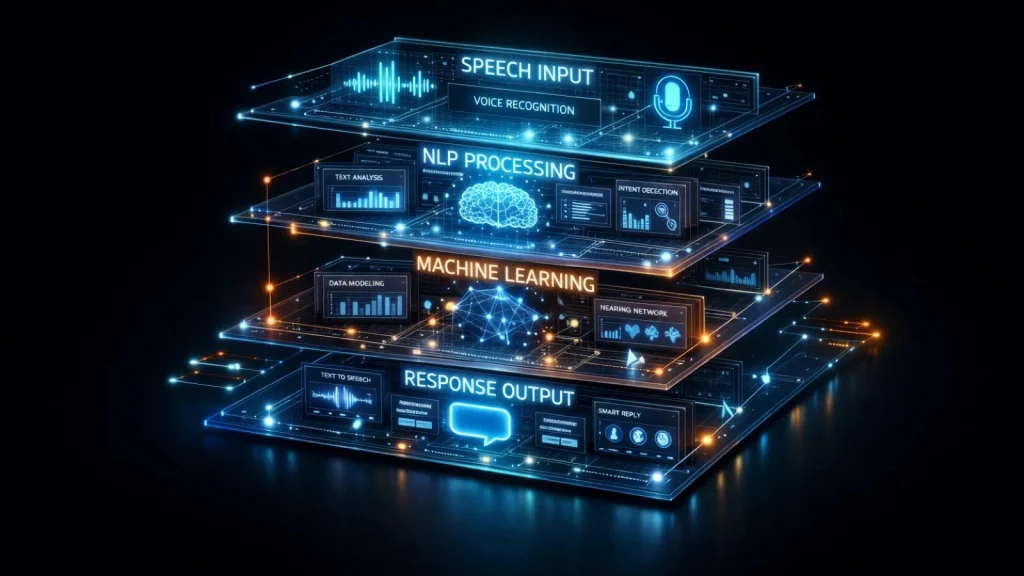
Behind every smooth conversation is a stack of technologies working together. But instead of diving into complexity, let’s simplify how it actually functions.
1. It Understands What You Mean
When you say something like, “I want to change my flight,” the system doesn’t just read words, it understands intent.
That’s powered by natural language processing (NLP). It can even understand variations like:
“Reschedule my ticket”
“Change my travel date”
“Move my flight”
All of these map to the same intent.
2. It Learns From Interactions
The more conversations it handles, the better it gets.
Machine learning helps it:
Recognize patterns
Improve responses
Predict user needs
Over time, this means fewer errors and faster resolutions.
3. It Listens and Speaks (For Voice Use Cases)
For voice-based systems like an AI voice agent, two key technologies come into play:
Speech recognition (turns voice into text)
Text-to-speech (turns responses back into voice)
Advanced systems also handle accents, background noise, and different speaking speeds, making conversations feel more natural.
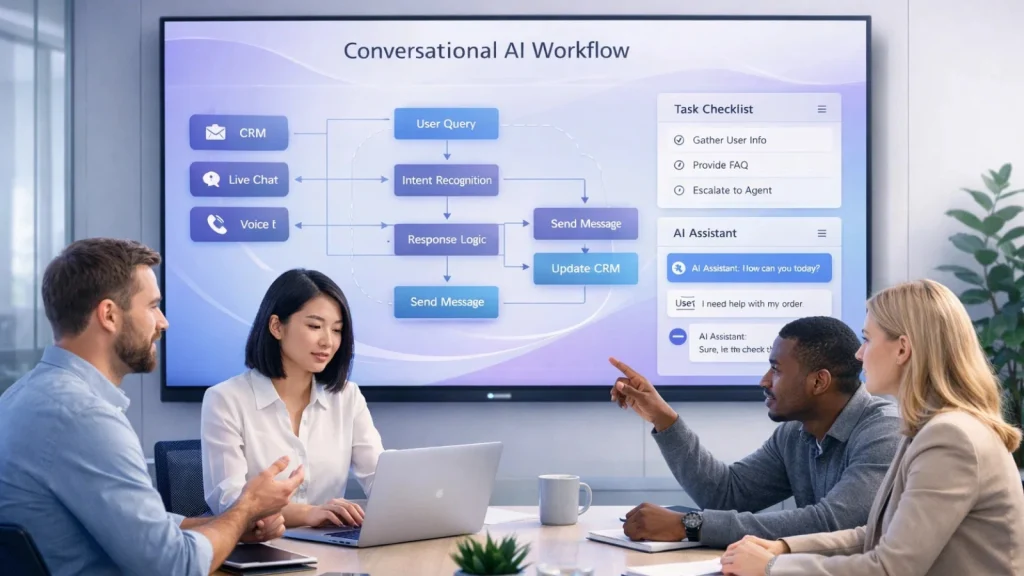
4. It Connects With Business Systems
This is where real value happens.
A strong conversational-AI platform integrates with:
CRM systems
Billing tools
Knowledge bases
Ticketing systems
So instead of just answering, it can:
Check order status
Reset passwords
Book appointments
This ability to take action is what separates basic tools from truly intelligent systems.
Conversational AI vs Chatbots: What’s the Difference?
Not all bots are created equal.
Traditional Chatbots
Rule-based
Follow scripts
Limited responses
Break easily when users deviate from expected inputs
Conversational AI
Understands context
Handles complex queries
Learns over time
Adapts responses dynamically
The Middle Ground
When chatbots are powered by conversational-AI, they become far more dynamic and human-like.
That’s when you start seeing real impact, especially in handling multi-step conversations.
Conversational AI vs Generative AI
This is where things often get confusing.
Generative AI creates content (text, images, code)
Conversational AI focuses on real-time dialogue
Think of it this way:
Generative AI writes.
Conversational AI talks.
Most modern systems use both, but conversational-AI is designed specifically for interaction, memory, and context across conversations.
Why Businesses Are Adopting Conversational AI
Here’s the reality: customers don’t want to wait, and employees don’t want repetitive work.
Conversational-AI solves both.
1. Instant Customer Support
No queues. No delays.
Customers get answers instantly, anytime, even outside business hours.
2. Lower Operational Costs
Handling thousands of queries manually is expensive.
AI reduces:
Cost per interaction
Dependence on large support teams
Training and onboarding costs
3. Consistent Experiences
Unlike humans, AI doesn’t:
Get tired
Miss information
Give inconsistent answers
Each interaction delivers the same standard of quality.
4. Better Employee Experience
Instead of handling repetitive queries, teams can focus on meaningful work.
That’s where converse AI tools act as assistants rather than replacements—supporting employees in real time rather than replacing them.
Real-World Conversational AI Examples
Let’s move beyond theory and look at how businesses are actually using it.
1. Customer Support Automation
This is one of the most common conversational-AI examples
Use cases:
Order tracking
Refund requests
FAQs
Customers get answers instantly without waiting for an agent, while companies handle higher volumes without scaling teams.
2. AI-Powered Call Centers
Instead of rigid IVR systems, companies are using AI voice agent solutions.
Now, customers can simply say:
“I want to check my balance”
And the system handles it naturally, routing, verifying, and resolving the request in seconds.
3. Appointment Booking
Healthcare, salons, and service businesses use AI to:
Book appointments
Send reminders
Reschedule instantly
This reduces no-shows and improves scheduling efficiency.
4. Internal HR & IT Support
Employees don’t need to raise tickets for every small issue.
AI can handle:
Leave balance queries
Password resets
Policy questions
This significantly reduces internal workload and speeds up response time.
5. Sales & Lead Qualification
AI chats with potential customers, asks relevant questions, and qualifies leads before passing them to sales teams.
This ensures sales teams focus only on high-intent prospects.
6. E-commerce Assistance
From product recommendations to checkout support, conversational AI enhances the entire buying journey, reducing drop-offs and improving conversions.
Beyond support and assistance, conversational-AI is also transforming how businesses approach outbound sales, and tools like Callified AI are a strong example of this shift.
Callified AI: Transforming Outbound Sales with Conversational AI
While most businesses focus on using conversational-AI for support, tools like Callified AI are also transforming how outbound sales is done, especially in high-volume environments.
Instead of relying on large telecalling teams, Callified AI works as an automated AI voice agent that can handle outreach at scale, manage conversations, and qualify leads in real time.
How Callified AI Works
Callified keeps things simple. No complex setup or technical expertise required.
1. Upload Your Leads
Import your data via CSV or connect your CRM. Segment and organize your leads easily.
2. AI Starts Calling Automatically
The AI voice agent dials each lead, speaks in Hindi, Hinglish, or English, and handles conversations, including basic objections and queries.
3. Get Qualified Appointments
Interested leads are identified during the call, and meetings are booked directly into your system.
What Makes Callified AI Stand Out
Callified AI is built specifically for Indian businesses handling outbound sales at scale.
Human-like Conversations
The AI voice agent communicates naturally, making interactions smooth and easy to followMultilingual Capabilities
Supports Hindi, Hinglish, and 10+ Indian languages, helping businesses reach wider audiencesHigh-Volume Calling at Scale
Run campaigns with large lead lists without increasing team sizeReal-Time Transcripts & Recordings
Every call is tracked, making it easier to review conversations and improve performanceSeamless CRM Integration
Syncs with tools like HubSpot, Salesforce, and Zoho for better workflow managementSmart Follow-Ups
Automatically retries missed calls and continues outreach based on defined rules
Conversational AI isn’t just improving conversations, it’s transforming how businesses generate results.
If you’re looking to scale outbound efficiently, trying a tool like Callified AI could be a smart next step.
Enterprise Use Cases That Deliver Real ROI
For large organizations, the impact goes deeper.
Customer-Facing Applications
Replacing IVR with natural conversations
Automating high-volume tasks
Supporting agents in real time
These directly impact customer satisfaction and service efficiency.
Internal Operations
IT help desk automation
HR assistance
Knowledge management
These reduce ticket volume and improve employee productivity.
Field Operations
Voice-first assistants help workers access information without stopping their work—especially useful in logistics, healthcare, and on-ground services.
Key Benefits of Conversational-AI
Let’s break down the real impact.
1. Faster Response Times
No waiting, no delays, just instant answers, even during peak hours.
2. Higher Customer Satisfaction
When problems are solved quickly and smoothly, satisfaction naturally increases—and so does retention.
3. Scalable Operations
AI can handle thousands of interactions simultaneously without performance drops.
4. Reduced Employee Burnout
Repetitive tasks are offloaded, making work more engaging and less exhausting.
5. Smarter Decision-Making
AI captures insights from every interaction:
Customer pain points
Common queries
Behavioral patterns
These insights help businesses continuously improve.
Best Practices for Implementing Conversational-AI
Adopting conversational AI isn’t just about plugging in a tool, it’s about designing better experiences.
1. Start Small but Strategic
Pick a high-impact use case like:
Password resets
Order tracking
This helps you test, learn, and scale effectively.
2. Focus on Integration
Your conversational AI platform should connect seamlessly with existing systems.
Without integration, AI becomes limited and less effective.
3. Always Include Human Backup
AI should assist, not replace.
Smooth handoffs to human agents are critical for complex or sensitive issues.
4. Measure Everything
Track:
Response time
Resolution rate
Customer satisfaction
These metrics help prove ROI and guide improvements.
5. Continuously Improve
AI learns, but only if you train and refine it regularly based on real conversations and feedback.
Challenges You Should Know About
While powerful, conversational AI isn’t perfect.
1. Poor Implementation
Badly designed systems frustrate users more than they help, especially if responses feel robotic.
2. Lack of Context
Without proper data integration, responses can feel generic and disconnected.
3. Over-Automation
Not every interaction should be handled by AI.
Balance is key, especially for emotional or complex situations.
The Future of Conversational AI
We’re just getting started.
The next phase of conversational AI will include:
More human-like voice interactions
Deeper personalization
Emotion-aware responses
Seamless omnichannel experiences
Conversations will become faster, smarter, and almost indistinguishable from human interactions.
Final Thoughts
The way businesses communicate is changing fast.
What used to take minutes (or hours) now happens in seconds.
What used to require human effort is now automated intelligently.
That’s the real power of conversational AI.
It’s not just about technology, it’s about creating smoother, faster, and more meaningful interactions at scale.
Whether you’re improving customer experience, reducing costs, or supporting your team, the impact is hard to ignore.
And as adoption grows, one thing is clear:
Conversations are becoming the new interface of business.
FAQs
1. What is conversational AI in simple terms?
It’s technology that allows people to talk to machines naturally through voice or text and get real-time responses.
2. How is conversational AI different from chatbots?
Traditional chatbots follow scripts, while conversational AI understands context and responds intelligently.
3. What industries use conversational AI?
It’s widely used in:
E-commerce
Healthcare
Banking
Customer support
HR and IT services
4. What is an AI voice agent?
An AI voice agent is a voice-based system that can handle phone conversations, answer queries, and complete tasks without human intervention.
5. Can conversational AI be used for outbound sales?
Yes, conversational AI can also power outbound sales by calling leads, qualifying prospects, and booking appointments automatically. Tools like Callified AI make it easier to scale this without increasing team size.